California Sweepstakes Casino Ban AB831: Legislative Updates
 Available in US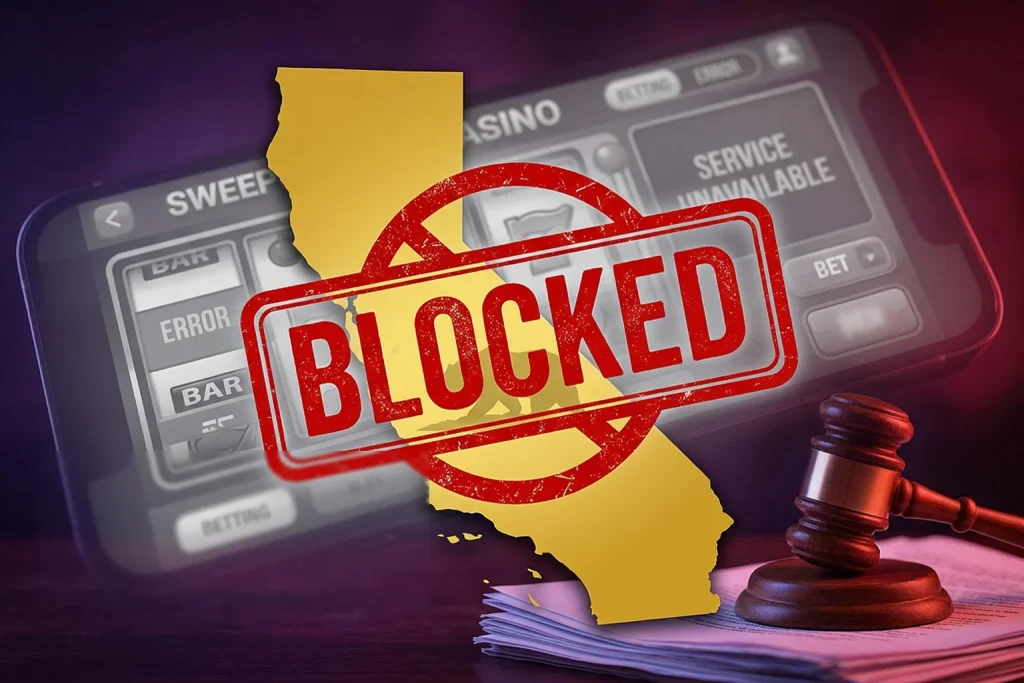
California players woke up on January 1, 2026, to blocked access. Sweepstakes casinos that had operated freely for years suddenly displayed “unavailable in your region” messages. AB831, the bill that seemed to materialize from nowhere and pass through the legislature at unprecedented speed, had taken effect. The largest state market for sweepstakes gaming went dark overnight.
The impact reverberates beyond California’s borders. The state represented approximately 17-20% of the entire US sweepstakes market, with projected 2025 sales of $2.42 billion. Industry forecasts from Eilers & Krejcik were revised downward specifically because of California’s exit—the 2025 national projection dropped from $4.7 billion to $4.0 billion.
This guide explains what AB831 actually does, how the legislative process unfolded, what the market impact looks like, and what options remain for California residents who enjoyed sweepstakes gaming.
AB831 Legislation Details: Enforcing the California Operations Ban
AB831 prohibits the operation of sweepstakes casinos accessible to California residents. The law classifies sweepstakes casino games as illegal gambling, removing the promotional sweepstakes defense that operators had relied upon. What was a legal gray area became definitively illegal.
The bill specifically targets the dual-currency model that defines sweepstakes casinos. Gold Coins purchased for entertainment? Still legal. But the attached Sweeps Coins—the currency redeemable for cash prizes—triggers the gambling classification. The promotional sweepstakes argument that had protected operators in other states found no shelter in California’s new framework.
Operators face civil penalties for continuing to serve California residents. The law empowers state regulators to pursue companies making their platforms available to Californians, creating compliance incentives that drove rapid platform exits. Most major sweepstakes casinos geoblocked California immediately upon the law taking effect.
Individual players face no criminal penalties under AB831. The law targets operators rather than users. Californians who previously played sweepstakes casinos haven’t committed crimes—they simply lost access to platforms that chose compliance over confrontation.
The bill passed with stunning margins: 36-0 in the Senate and 63-0 in the Assembly. Not a single legislator voted against it. This unanimity reflected the unusual coalition supporting the ban—tribal gaming interests, traditional casino operators, and consumer protection advocates all found common cause against sweepstakes platforms.
Governor Newsom signed AB831 into law in October 2025, with an effective date of January 1, 2026. The compressed timeline from introduction to implementation gave operators minimal runway to adapt—or to mount effective opposition.
Timeline of Events
The legislative journey of AB831 moved remarkably fast by Sacramento standards—some said suspiciously fast.
The bill emerged in mid-2025 with immediate momentum. Committee hearings that typically stretch over weeks compressed into days. Amendments that might generate debate passed without significant opposition. The accelerated pace prompted industry criticism that proper deliberation never occurred.
Jason Giles, Executive Director of the National Indian Gaming Association, captured industry sentiment: “AB 831 is moving way too fast for anyone to comprehend.” The speed suggested coordinated effort rather than organic legislative development—tribal gaming interests and traditional casinos had long sought sweepstakes restrictions, and AB831 delivered their preferred outcome.
Tribal gaming tribes viewed sweepstakes casinos as competitors operating outside the regulatory framework they’d negotiated through state compacts. Traditional card rooms and casinos saw customer dollars flowing to unregulated digital platforms. Both groups wielded substantial lobbying power in Sacramento.
The Social Gaming Leadership Alliance attempted to rally opposition, with Executive Director Jeff Duncan urging Governor Newsom to veto the bill and “work with us to create smart, consumer-focused regulation that strengthens California’s economy.” That argument failed to gain traction—Newsom signed without apparent hesitation.
Between signing and implementation, sweepstakes platforms scrambled to communicate with California users. Account notifications explained impending access restrictions. Withdrawal processes were expedited to ensure Californians could redeem existing balances before the January deadline.
January 1, 2026, arrived with most platforms already blocking California IP addresses. The transition, while disruptive for users, proceeded without major technical failures or disputed balances—operators had prioritized clean exits over contested prolonged access.
Market Impact
California’s exit reshaped industry projections and competitive dynamics across the sweepstakes sector.
The immediate financial impact concentrated on operators with heavy California exposure. Platforms where California represented above-average market share suffered disproportionate revenue losses. Some smaller operators faced existential questions about viability without their largest state market.
Eilers & Krejcik’s revised forecasts tell the story quantitatively. The 2025 projection dropped from $4.7 billion to $4.0 billion—a $700 million reduction attributable largely to California. The 2026 forecast shows further decline to $3.6 billion, representing a 10% year-over-year contraction. For an industry that had grown 60-70% annually since 2020, the reversal is stark.
California’s estimated $300 million in potential annual tax revenue from regulated sweepstakes also vanished—though that revenue was always theoretical, requiring regulation that never materialized. Tribal interests preferred no sweepstakes gaming to regulated competition; they got their preference.
Remaining state markets gained relative importance. Texas, Florida, and other large states where sweepstakes remain accessible became more valuable as customer acquisition targets. Marketing spending shifted toward jurisdictions where growth remained possible.
New York’s subsequent ban compounded California’s impact. The two states together represented roughly 25% of the US sweepstakes market. Losing both within months fundamentally altered industry economics and growth trajectories.
Surviving platforms face structural questions. Can the remaining accessible markets support the infrastructure built during expansion? Will regulatory pressure spread to additional states? The optimistic growth narrative that attracted investment has given way to defensive positioning.
Alternatives for CA Players
California residents who enjoyed sweepstakes casinos have limited options—none replicating the exact experience they lost.
Social casinos remain legal and accessible. Platforms like Slotomania, DoubleDown, and similar apps offer slot gameplay without cash prize redemption. Gold Coins have entertainment value only; no Sweeps Coins exist. For players who enjoyed the games themselves rather than the prize potential, social casinos provide partial substitution.
Tribal casinos operate throughout California with legitimate, regulated gaming. The experience differs dramatically from mobile convenience—physical travel required, different game selection, different atmosphere. But real-money slot play exists for those willing to visit physical locations.
Daily fantasy sports platforms like DraftKings and FanDuel operate in California as skill-based contests rather than gambling. The gameplay differs entirely from casino-style entertainment, but they offer legal prize opportunities unavailable through sweepstakes.
Some California residents relocated their accounts through VPN circumvention—this approach carries risks. Platforms detecting VPN usage typically freeze accounts and withhold balances. Terms of service universally prohibit geographic circumvention. The risk-reward calculation rarely favors attempted evasion.
Patience represents another option. Legislative environments change; future California legislatures might adopt different approaches. Regulated sweepstakes or iGaming frameworks could emerge—though tribal opposition makes such developments uncertain at best.
After the Gold Rush
California’s sweepstakes ban marks a turning point in industry history. The era of unlimited expansion into any state without explicit prohibition has ended. Operators now face active regulatory hostility in major markets rather than passive tolerance.
The speed and unanimity of AB831’s passage signals what determined opposition can achieve. Tribal gaming interests demonstrated that their lobbying power extends to emerging digital competitors, not just traditional rivals. Future expansion plans must account for similar organized resistance.
For California players, the ban represents genuine loss—entertainment options narrowed, prize opportunities eliminated, platforms enjoyed for years suddenly inaccessible. Whether that loss motivates political engagement toward future liberalization or simple resignation remains to be seen. The immediate reality is clear: sweepstakes casinos no longer serve California.