New York Sweepstakes Casino Ban S.5935A: Market Restrictions
 Available in US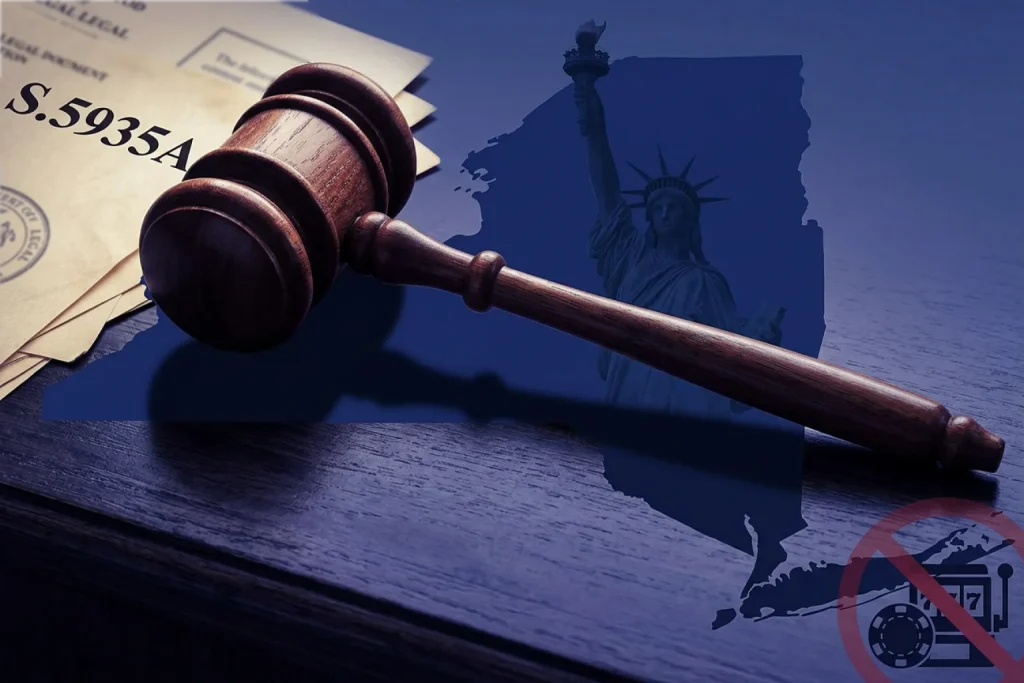
New York declared war on sweepstakes casinos in 2025, and the state wasn’t bluffing. Governor Hochul signed S.5935A into law on December 8, 2025, joining California in explicitly banning platforms that had operated in regulatory gray zones. The Empire State’s sweepstakes market—worth an estimated $762 million in 2024 sales—effectively ceased to exist.
Unlike California’s tribal-gaming-driven ban, New York’s approach emphasized consumer protection and existing gambling regulatory frameworks. The state argued sweepstakes casinos constituted illegal gambling regardless of the promotional sweepstakes framing—and backed that argument with enforcement teeth.
This guide explains what S.5935A prohibits, the penalty structure operators face, how the Attorney General’s office has pursued enforcement, and what the future might hold for online gaming in New York.
S.5935A Legislation Impact: Restricting New York Virtual Casinos
S.5935A classifies sweepstakes casino games as illegal gambling under New York law. The bill strips away the promotional sweepstakes defense, declaring that games offering cash prizes through virtual currency systems constitute gambling requiring state authorization—authorization that sweepstakes platforms lack.
Senator Joseph P. Addabbo Jr., Chair of the Senate Racing, Gaming & Wagering Committee, articulated the legislative logic clearly: “If a game on your phone or computer looks like a casino game, acts like a casino game, and pays out real money winnings like a casino game, then it is a casino gambling game, thus currently illegal and should not operate in New York without proper regulation, safeguards, and accountability.”
The law targets the fundamental mechanics that distinguish sweepstakes casinos from pure social gaming. Purchasing Gold Coins with attached Sweeps Coins creates the consideration element of gambling under New York’s framework. The randomized game outcomes constitute chance. The cash prize redemption represents prize. All three gambling elements present—illegal.
Operators cannot circumvent the ban through structural modifications. The law’s language covers any system where virtual currency purchases enable access to cash-redeemable gameplay, regardless of how the relationship between currencies is structured or marketed.
The bill received bipartisan support in both chambers. New York legislators—like their California counterparts—found consensus in restricting unregulated gaming, though motivations varied from consumer protection to protecting existing gaming interests to moral objections to gambling expansion.
Implementation was immediate upon signing. Unlike California’s January 1 effective date, S.5935A took force upon Hochul’s signature in December 2025. Platforms had even less time to prepare orderly exits than their California timelines allowed.
Penalty Structure
New York imposed meaningful financial penalties for operators who continue serving state residents. The penalty structure ranges from $10,000 to $100,000 per violation, with each day of continued operation potentially constituting separate violations.
The escalating penalty framework creates powerful compliance incentives. An operator serving New York residents for 30 days post-ban could theoretically face $3 million in penalties at the maximum rate. Few operators possess appetite for such exposure, particularly given enforcement activity already underway.
Civil rather than criminal penalties define the regime. Operators face financial consequences rather than imprisonment—the state prioritized making non-compliance economically irrational rather than pursuing criminal prosecutions. This approach streamlined enforcement without requiring criminal court proceedings.
The penalty structure applies to operators, not individual players. New York residents who accessed sweepstakes casinos before the ban committed no offenses; those who might attempt access after face no personal criminal liability. The law targets supply rather than demand.
Payment processor liability creates additional pressure points. Facilitating transactions for illegal gambling exposes financial institutions to potential liability. Major payment processors preemptively blocked sweepstakes casino transactions involving New York addresses, cutting platforms off from customer funds even where platform access might technically persist.
Corporate officers and directors may face personal exposure under New York’s corporate accountability frameworks. Decisions to continue serving New York despite the ban could trigger individual liability beyond corporate penalties—a consideration that likely influenced rapid platform withdrawals.
AG Enforcement Actions
New York’s Attorney General didn’t wait for legislation to act against sweepstakes casinos. Enforcement activity preceded S.5935A’s passage, establishing precedent and signaling seriousness.
In June 2025, Attorney General Letitia James issued cease-and-desist letters to 26 sweepstakes platforms. These letters demanded immediate cessation of services to New York residents, citing existing gambling prohibitions. The pre-legislation enforcement established that New York considered sweepstakes casinos illegal under pre-existing law—S.5935A merely clarified and strengthened that position.
Most platforms complied with cease-and-desist demands. The risk calculus favored voluntary withdrawal over contested enforcement—fighting the New York AG requires resources, creates negative publicity, and rarely succeeds against well-funded state legal teams. Platforms that had customers nationwide couldn’t justify New York-specific legal battles.
Non-compliant operators faced escalating consequences. Platforms ignoring cease-and-desist letters became targets for formal enforcement actions, including penalty assessments and potential injunctive relief blocking their services entirely from New York networks.
The AG’s office coordinated with payment processors to maximize enforcement effectiveness. When operators couldn’t receive or process payments from New York residents, continued service became economically pointless. Financial infrastructure enforcement complemented direct legal action.
Ongoing monitoring ensures compliance persists. The AG maintains watchlists of known sweepstakes platforms and periodically tests accessibility from New York. Platforms that relax geoblocking after initial compliance face renewed enforcement attention.
What’s Next for NY
New York’s sweepstakes ban exists alongside broader debates about online gaming legalization. The state that banned sweepstakes might eventually authorize regulated iGaming—the contradiction is more apparent than real.
Licensed online casino gaming remains under legislative consideration. Multiple bills proposing regulated iGaming have circulated through Albany, though none have achieved passage. Powerful interests both support and oppose legalization—the outcome remains genuinely uncertain.
Mobile sports betting’s success provides a template. New York launched regulated mobile sports betting in 2022 to significant revenue generation. Extending similar frameworks to casino gaming follows logical precedent, though implementation complexity and political obstacles differ.
Tribal gaming interests complicate iGaming prospects, as they did in California. New York tribes operate casinos under compacts that might require renegotiation if online gaming launched. These negotiations involve revenue sharing, exclusivity provisions, and political relationships that resist simple resolution.
Traditional commercial casinos also influence outcomes. Properties like Resorts World and del Lago invested billions in physical infrastructure; online gaming that cannibalizes their revenue faces their opposition. Alternatively, operators might prefer capturing online revenue themselves to watching it flow elsewhere.
The sweepstakes ban might accelerate legalization debates. With unregulated platforms blocked, the choice becomes regulated iGaming or no online casino gaming at all. Some legislators view this clarity as helpful—others preferred the status quo where sweepstakes provided gaming access without state involvement.
Neighboring states provide both precedent and pressure. New Jersey’s successful iGaming market demonstrates what regulated online casinos can generate. Pennsylvania followed successfully. New York watching tax revenue flow to neighbors creates political pressure that purely theoretical arguments don’t.
Regulation Versus Prohibition
New York chose prohibition over regulation, at least for now. The state could have licensed sweepstakes operators, imposed consumer protections, collected tax revenue, and maintained player access. Instead, it banned the entire category while considering whether to authorize something else eventually.
This choice reflects specific political calculations rather than universal principles. California’s tribal interests made regulation impossible; New York’s considerations differed but led to the same outcome. Other states watching these examples will draw their own conclusions about how to approach sweepstakes platforms in their jurisdictions.
The enforcement apparatus built for prohibition could pivot toward regulation. Infrastructure for identifying and blocking sweepstakes operators could theoretically license and monitor them instead. The transition would require legislative change, but operational capabilities exist.
For New York residents who enjoyed sweepstakes gaming, the ban creates the same practical impact as California’s—lost access, eliminated options, entertainment removed. Whether regulated alternatives eventually emerge offers cold comfort to players locked out today. The present reality is prohibition; the future remains genuinely uncertain.