Slot Volatility at Sweepstakes Casinos: Variance and Payouts
 Available in US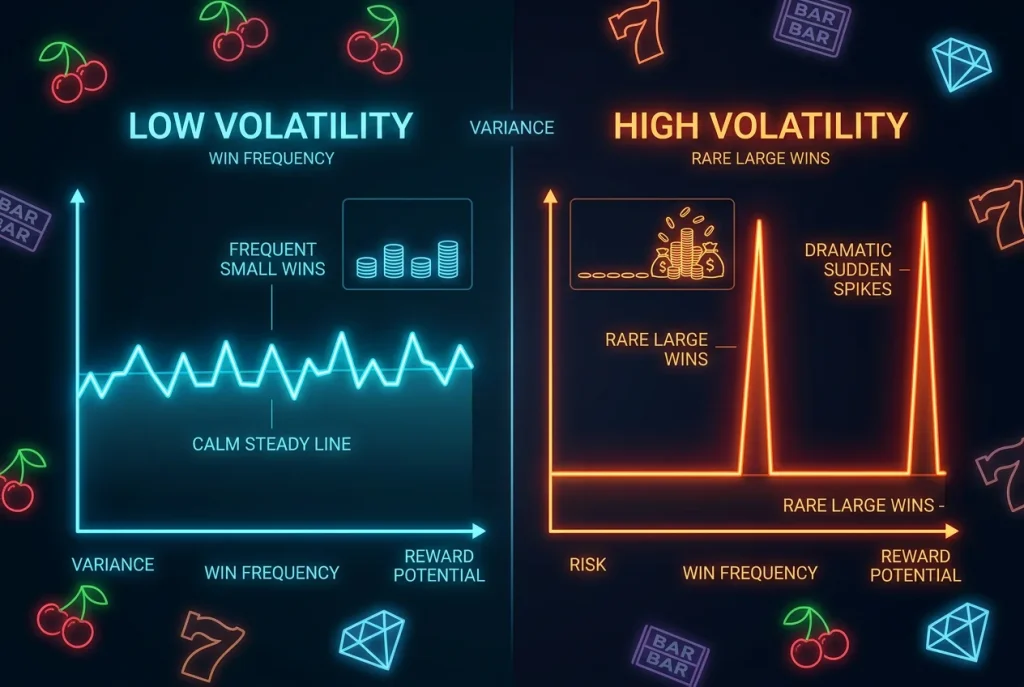
Two slots with identical 96% RTP can deliver completely different experiences. One pays small wins constantly, keeping your balance stable through extended sessions. The other pays nothing for dozens of spins, then delivers a massive bonus that multiplies your stake hundreds of times. The difference is volatility—and understanding it transforms how you approach slot selection.
Volatility measures win distribution patterns rather than overall return rates. High volatility concentrates returns into rare large wins; low volatility spreads returns across frequent small wins. Both can achieve the same long-term RTP while providing radically different short-term experiences.
This guide explains what volatility means, compares low and high volatility gameplay, identifies popular games at each volatility level, and helps you choose the right variance for your preferences and bankroll.
Slot Variance Mechanics: Calculating Hit Frequency and Risk
Volatility—also called variance—describes how slot payouts distribute over time. It’s independent of RTP, which measures total returns over infinite play. Volatility describes the journey; RTP describes the destination.
Imagine two hypothetical slots, both with 96% RTP. Slot A returns exactly 96 cents per dollar wagered on every spin—perfectly smooth, no variance. Slot B pays nothing for 99 spins, then pays $96 on spin 100. Both achieve 96% RTP mathematically, but the experience differs dramatically.
Real slots fall between these extremes, but the principle holds. Low volatility slots pay frequently with modest wins. High volatility slots pay rarely with substantial wins. Medium volatility balances between extremes.
According to Easy Vegas analysis, online slots average around 96% RTP compared to 91-93% at land-based casinos. This favorable baseline applies across volatility levels—but volatility determines whether you’ll experience that 96% as steady returns or dramatic swings.
Volatility affects bankroll requirements. Low volatility slots sustain extended play on modest stakes; your balance fluctuates gently around its starting point. High volatility slots can drain bankrolls completely before hitting significant wins; they require larger stakes or higher risk tolerance. Understanding this relationship prevents frustration when high-volatility sessions don’t match low-volatility expectations.
Game providers typically disclose volatility ratings, though terminology varies. Some use “low/medium/high”; others use numerical scales; some provide no information at all. When official ratings aren’t available, community testing and experience databases fill the gap.
Low vs High Volatility
Choosing between volatility levels involves trade-offs matching your goals and circumstances.
Low volatility slots provide steady entertainment with predictable session outcomes. Wins come frequently—sometimes every few spins—keeping balances relatively stable. Individual wins rarely exceed 20-50x stake; bonus features trigger more often but pay more modestly. These slots suit players prioritizing play time over jackpot potential, those with limited bankrolls who can’t absorb extended losing streaks, and anyone who finds dramatic swings stressful rather than exciting.
High volatility slots deliver feast-or-famine experiences. Base games often feel unrewarding—many spins return nothing, small wins barely dent losses. But bonus features, when they finally trigger, can pay hundreds or thousands of times your stake. These slots suit players chasing big wins rather than extended entertainment, those with bankrolls sufficient to survive cold streaks, and players who find volatility exciting rather than frustrating.
Medium volatility compromises between extremes. Wins come more frequently than high volatility but less than low; individual wins exceed low volatility potential but rarely match high volatility peaks. Medium volatility works for players uncertain which extreme suits them, or those seeking balanced experiences without committing to either end.
Slot configurability complicates volatility understanding. The same game can run at different RTP settings ranging from 85% to 98% depending on casino choices. Lower RTP configurations might alter effective volatility—the game feels “tighter” because fewer wins occur at any size. Platform selection affects volatility experience alongside game selection.
Session length interacts with volatility meaningfully. Short sessions on high volatility slots often end in total loss or dramatic gain—variance dominates outcomes. Longer sessions allow regression toward expected returns, smoothing volatility’s impact. Plan session lengths according to volatility tolerance.
Top Games by Volatility
Specific games illustrate volatility categories concretely. The following examples appear commonly at sweepstakes casinos.
Low volatility favorites:
Starburst (NetEnt) defines low volatility slot play. Frequent small wins, expanding wilds providing regular excitement, and gentle bankroll fluctuation make it perfect for extended casual sessions. Maximum win potential is limited, but consistent entertainment compensates.
Blood Suckers (NetEnt) combines low volatility with favorable RTP exceeding 98% in optimal configurations. The vampire theme includes bonus features without extreme variance. Excellent for players prioritizing return percentage over win magnitude.
Thunderstruck II (Microgaming) offers medium-low volatility with more feature variety than pure low-volatility games. Multiple bonus modes provide engagement without extreme swings.
High volatility favorites:
Dead or Alive 2 (NetEnt) epitomizes high volatility. Base game grinds relentlessly; bonus rounds can pay 100,000x+ stake. Sessions often end in complete loss or spectacular triumph. Only appropriate for players with bankrolls and temperaments matching its demands.
Gates of Olympus (Pragmatic Play) delivers tumbling reels with multipliers that can stack dramatically during bonus rounds. Extended dry spells punctuated by potentially massive cluster wins define the experience.
Wanted Dead or a Wild (Hacksaw Gaming) pushes volatility further than most mainstream providers. Bonus buy options let players skip base game entirely, jumping directly into high-variance features. Not for the risk-averse.
Medium volatility options:
Sweet Bonanza (Pragmatic Play) balances frequent tumble wins against significant multiplier potential. Sessions feel engaging without extreme punishment; big wins occur without requiring endless base game grinding.
Book of Dead (Play’n GO) provides medium-high volatility with manageable bankroll demands. Expanding symbols during free spins create win potential without Dead or Alive 2’s extremity.
Choosing the Right Volatility
Match volatility selection to your actual circumstances rather than aspirational preferences.
Assess your bankroll honestly. High volatility slots require stakes you can lose repeatedly without distress. If losing 100 spins’ worth of bets would create financial problems, high volatility isn’t appropriate regardless of how exciting big wins seem. Low volatility lets smaller bankrolls last longer with lower risk of complete depletion.
Consider your session goals. Want an hour of entertainment with modest outcomes? Low volatility delivers reliably. Hunting for dramatic wins that justify streaming or social sharing? High volatility provides those moments—rarely, expensively, but memorably. Define what success means before selecting games.
Evaluate your emotional response to variance. Some players find losing streaks frustrating and demoralizing; others find them exciting, building anticipation for eventual big wins. Neither response is wrong, but choosing volatility mismatched to your temperament creates unpleasant sessions regardless of outcomes.
Experiment across volatility levels. Play low, medium, and high volatility games to experience each personally. Intellectual understanding of volatility differs from visceral experience. A few sessions across the spectrum reveal your actual preferences better than theoretical analysis.
Adjust volatility to circumstances. High volatility might suit weekend sessions with dedicated bankroll; low volatility might suit casual weeknight entertainment. Flexibility across volatility levels maximizes enjoyment across varying contexts.
Variance as Strategy
Volatility understanding transforms slot selection from random choice to strategic decision. The game that matches your bankroll, session goals, and emotional preferences will deliver better experiences than objectively “better” games mismatched to your situation.
No volatility level is superior—they serve different purposes for different players. The player seeking two hours of entertainment and the player seeking one screenshot-worthy win need different games. Both can find satisfaction when volatility selection aligns with expectations.
Sweepstakes casino slot libraries typically span the volatility spectrum. Informed players navigate these options deliberately rather than randomly, selecting games that serve their actual goals. That deliberate selection—more than any particular game choice—determines session satisfaction.